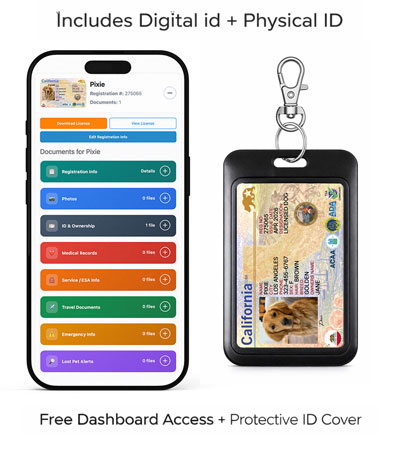
Garfield County Dog Registration Information
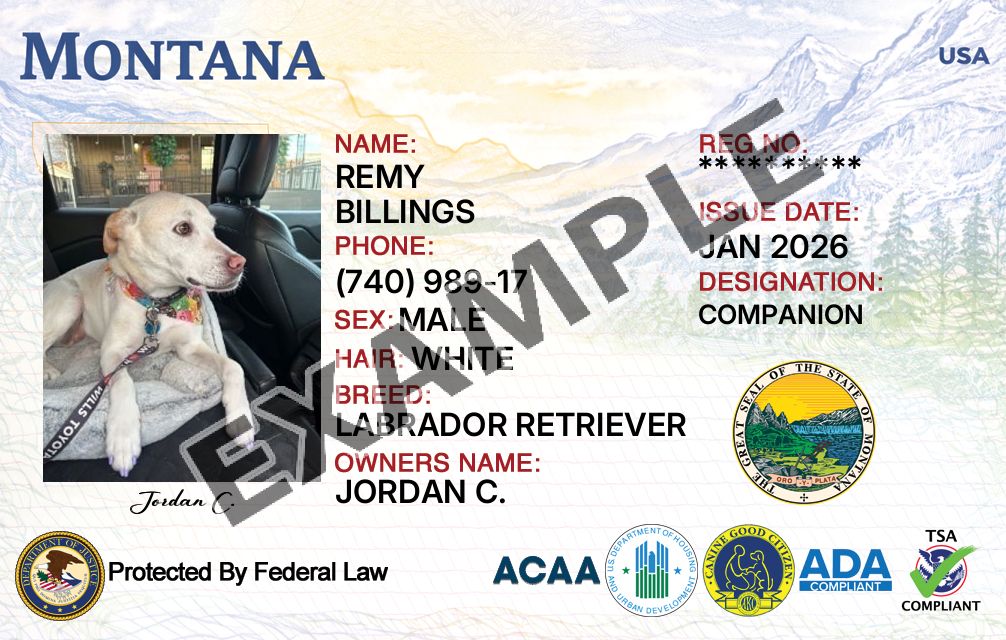
Service Dogs and Emotional Support Animals in Garfield, Montana
If you’re searching where do I register my dog in Garfield County, Montana for my service dog or emotional support dog, the answer usually depends on local rules. In Montana, there is no single “statewide service dog registration” for public access, and dog licensing is typically handled locally (county, city, or sometimes through law enforcement/animal control practices depending on the community).
This page explains how a dog license in Garfield County, Montana generally works, where residents often start when asking where to register a dog in Garfield County, Montana, what to expect regarding rabies vaccination, and the difference between dog licensing, service dog legal status, and emotional support animal rules.
Overview of Dog Licensing in Garfield County, Montana
Is there a single “Garfield County service dog registration” office?
In most U.S. counties, there is no government office that “registers” a service dog to make it legally a service dog. Under federal ADA guidance, businesses and public entities generally cannot require documentation proving a dog is a service animal as a condition of entry, and staff are limited to two questions when it’s not obvious the dog is a service animal. That means the “registration” question is usually really about local dog licensing, rabies compliance, or animal control contact points—not an ADA service dog registry.
What “registration” usually means in practice
When residents ask about animal control dog license Garfield County, Montana, they’re usually looking for one (or more) of the following:
- A local dog license (if required by local ordinance)
- A rabies vaccination tag/certificate requirement or enforcement process
- Who to call for animal control, stray dogs, bites, or nuisance complaints
- How to comply when moving, changing addresses, or updating ownership details
Rabies vaccination in Montana (statewide vs local rules)
Montana does not have a single statewide rule that forces every pet dog to be vaccinated for rabies in every circumstance, but state agencies recommend rabies vaccination and Montana has rabies-related public health reporting and response practices. Many cities and some counties can have their own vaccination or licensing requirements, and proof of rabies vaccination is commonly required to obtain a local license where licensing programs exist.
Where to Register or License Your Dog in Garfield County, Montana
Because dog licensing is often handled locally, below are example official offices within Garfield County, Montana where residents commonly start to ask about a dog license in Garfield County, Montana, local animal ordinances, rabies enforcement practices, or who provides animal control response. These offices can help you confirm whether a license is required in your part of the county (for example, within town limits vs. rural/unincorporated areas) and what paperwork and fees apply.
Official Offices (Examples)
Garfield County Sheriff/Coroner
Street address: 352 Leavitt Ave
City/State/ZIP: Jordan, MT 59337
Phone: (406) 557-2540
Office hours: Not listed
Garfield County Clerk & Recorder
Mailing address: P.O. Box 7
City/State/ZIP: Jordan, MT 59337
Phone: (406) 557-2760
Email: clerk@garfieldco.us
Office hours: Not listed
Garfield County Clerk of District Court
Street address: Garfield County Courthouse, 352 Leavitt Ave
City/State/ZIP: Jordan, MT 59337
Phone: (406) 557-6254
Office hours: Not listed
Garfield County Health Nurse
City/State/ZIP: Jordan, MT 59337
Phone: (406) 557-2050
Office hours: Monday, Tuesday, Thursday: 9am - 5pm
How Dog Licensing Works Locally in Garfield County, Montana
County vs. city rules (why the answer can depend on your address)
In Montana, dog licensing and enforcement are commonly handled at the local level. That means requirements can vary depending on whether you live:
- Inside a town’s incorporated limits (city/town rules may apply)
- In an unincorporated/rural part of the county (county rules or enforcement practices may differ)
- In housing with pet rules (leases, HOA rules, or specific property policies—separate from licensing)
If you’re specifically trying to confirm a dog license in Garfield County, Montana, the most practical approach is to call one of the official offices listed above and ask: “Do I need a county license, a city license, or only rabies documentation where I live?”
What you’ll usually need (documents and common steps)
When a local licensing requirement exists, you typically complete a short application and pay a fee. Many jurisdictions require the license to be renewed periodically and provide a tag for the dog’s collar. Requirements vary by local ordinance, but common items include:
Common licensing steps
- Confirm whether your specific location in Garfield County requires licensing (county vs town limits).
- Get a current rabies vaccination from a licensed veterinarian and keep the certificate.
- Submit proof of rabies vaccination and pay the licensing fee (if licensing is required).
- Attach any issued tags to your dog’s collar/harness.
- Update your contact information if you move or change phone numbers.
Rabies, animal bites, and why proof matters even when licensing is unclear
Even in places where a formal license program is limited or varies by locality, rabies documentation matters because it can affect what happens if:
- Your dog bites someone (or is accused of biting)
- Your dog is bitten by a wild animal or has a possible rabies exposure
- Your dog is picked up as a stray and needs to be returned
If you are unsure, keep a printed or digital copy of your dog’s rabies certificate in a safe place. If local officials request proof in an incident context, having it quickly available can reduce delays and confusion.
Service Dog Laws in Garfield County, Montana
Service dogs are not “licensed” into existence
A service dog is defined under federal ADA guidance as a dog that is individually trained to do work or perform tasks for a person with a disability. A service dog’s legal status is based on training and disability-related tasks—not on buying a vest, paying a website fee, or obtaining a “certificate.”
Can a business or office demand service dog registration papers?
In general, no. ADA guidance explains that covered entities may not require documentation (proof of certification, training, or licensing) as a condition for entry. If it is not obvious that the dog is a service animal, staff are generally limited to asking two questions:
The two questions commonly allowed (when not obvious)
- Is the dog a service animal required because of a disability?
- What work or task has the dog been trained to perform?
Staff generally cannot ask about your diagnosis, require a special ID card, or demand that your dog demonstrate its tasks on the spot. However, service dogs must still be under control and housebroken, and they can be removed if they are out of control or not housebroken.
How local licensing interacts with service dogs
A service dog may still be subject to neutral local public health rules that apply to all dogs (such as vaccination, leash laws, and potentially local dog licensing). In other words, having a service dog does not automatically eliminate local compliance expectations—especially around rabies or bite-response procedures.
Emotional Support Animal Rules in Garfield County, Montana
An ESA is not the same as a service dog
An emotional support animal (ESA) provides emotional support that alleviates one or more effects of a disability. Unlike service dogs, ESAs are not granted the same broad public-access rights under the ADA for places like restaurants, stores, or most public-facing businesses.
Where ESA rights most commonly apply: housing
ESAs most often come up in housing situations (rentals, housing providers, or HOA contexts) where a person requests a reasonable accommodation related to a disability. Housing providers may have processes for handling accommodation requests and may request reliable information when the disability-related need is not obvious.
Do you “register” an ESA with the county?
Typically, no. There is usually no county ESA registration that creates legal protection. If you are also trying to comply with local rules, you may still need whatever applies to dogs generally in your location (such as rabies compliance and, where applicable, a local license).
Frequently Asked Questions
Suggested script
“I’m trying to confirm whether I need a local dog license in Garfield County, Montana, and if so, which office issues it. I also want to confirm what rabies documentation is required and where to submit it.”
Register A Dog In Other Montana Counties
Select your county below to get started with your dog’s ID card. Requirements and license designs may vary by county, so choose your location to see the correct options and complete your pup’s registration.
- Beaverhead County Dog Registration
- Big Horn County Dog Registration
- Blaine County Dog Registration
- Broadwater County Dog Registration
- Carbon County Dog Registration
- Carter County Dog Registration
- Cascade County Dog Registration
- Chouteau County Dog Registration
- City of Anaconda County Dog Registration
- City of Butte County Dog Registration
- Custer County Dog Registration
- Daniels County Dog Registration
- Dawson County Dog Registration
- Deer Lodge County Dog Registration
- Fallon County Dog Registration
- Fergus County Dog Registration
- Flathead County Dog Registration
- Gallatin County Dog Registration
- Glacier County Dog Registration
- Golden Valley County Dog Registration
- Granite County Dog Registration
- Hill County Dog Registration
- Jefferson County Dog Registration
- Judith Basin County Dog Registration
- Lake County Dog Registration
- Lewis and Clark County Dog Registration
- Liberty County Dog Registration
- Lincoln County Dog Registration
- Madison County Dog Registration
- McCone County Dog Registration
- Meagher County Dog Registration
- Mineral County Dog Registration
- Missoula County Dog Registration
- Musselshell County Dog Registration
- Park County Dog Registration
- Petroleum County Dog Registration
- Phillips County Dog Registration
- Pondera County Dog Registration
- Powder River County Dog Registration
- Powell County Dog Registration
- Prairie County Dog Registration
- Ravali County Dog Registration
- Richland County Dog Registration
- Roosevelt County Dog Registration
- Rosebud County Dog Registration
- Sanders County Dog Registration
- Sheridan County Dog Registration
- Silver Bow County Dog Registration
- Stillwater County Dog Registration
- Sweet Grass County Dog Registration
- Teton County Dog Registration
- Toole County Dog Registration
- Treasure County Dog Registration
- Valley County Dog Registration
- Wheatland County Dog Registration
- Wibaux County Dog Registration
- Yellowstone County Dog Registration